

If you are thinking about whether to Invest in Dubai Real Estate in 2026, you are probably hearing the same things from every direction: oversupply, higher borrowing costs, slower growth, and endless advice to wait.
I understand why that makes people nervous. But after investing in Dubai since 2003, through the pre-2008 speculation boom, the global financial crisis, and the recent recovery cycle, I can tell you this with confidence: the market rarely punishes people simply for timing. It punishes them for poor execution.
That distinction matters.
The investors who wait for the “perfect” time often do nothing for years. On the other hand, the investors who buy the wrong property, even in a good market, end up holding units they struggle to rent or sell without taking a hit.
So the real question is not whether 2026 is a bad year to Invest in Dubai Real Estate. The real question is whether you know how to separate resilient opportunities from crowded, low-quality stock.
The fears around 2026 are real, but they are not the whole story
Let’s be honest about the headwinds first.
There are legitimate reasons people feel cautious about Dubai in 2026:
- Mortgage rates are higher than they were in 2021 and 2022
- Affordability is tighter for many buyers
- Price growth has slowed from the explosive gains of the recent run-up
- A large supply pipeline is being discussed across the market
These are not fake concerns. They are real market pressures, and anyone planning to Invest in Dubai Real Estate should factor them in seriously.
The mistake is going to either extreme.
Some investors ignore the risks completely and assume everything will keep rising forever. Others become so focused on the risks that they freeze and do nothing. Both approaches can be expensive.
The better approach is simple: acknowledge the headwinds, understand what they actually mean, and then make decisions based on reality rather than noise.
The so-called supply crisis is being misunderstood
The biggest fear in the market right now is supply.
People see headlines about huge future pipelines, hundreds of thousands of units planned, and immediately assume all of that inventory will hit the market exactly on schedule and crush prices.
That is not how Dubai works in practice.
One of the most important lessons in this market is that planned supply and actual delivered supply are two very different things.
For example, even if around 66,000 units are scheduled for delivery in 2025, a more realistic completion range is closer to 30,000 to 40,000 units.
For 2026 and 2027, the same logic applies. The market may talk about huge future pipelines, but a practical estimate for actual annual delivery is closer to 45,000 to 60,000 units per year.
Why the gap?
Because developers do not consistently deliver 100% of what they schedule. Historically, many only deliver roughly 50% to 60% of announced supply within expected timelines.
That gap between headlines and reality is where many investors get misled. They react to the announcement rather than the actual likely delivery.
If you want to Invest in Dubai Real Estate intelligently, do not make decisions based on pipeline headlines alone. Look at:
- Historical delivery rates
- Developer execution track record
- Realistic completion timelines
- Whether the announced stock is actually likely to be absorbed
The scary oversupply story starts to look very different once you strip out the marketing noise.
Supply only matters when you compare it to demand
This is the part too many people miss.
Housing supply means nothing in isolation. It only matters relative to how many people need homes.
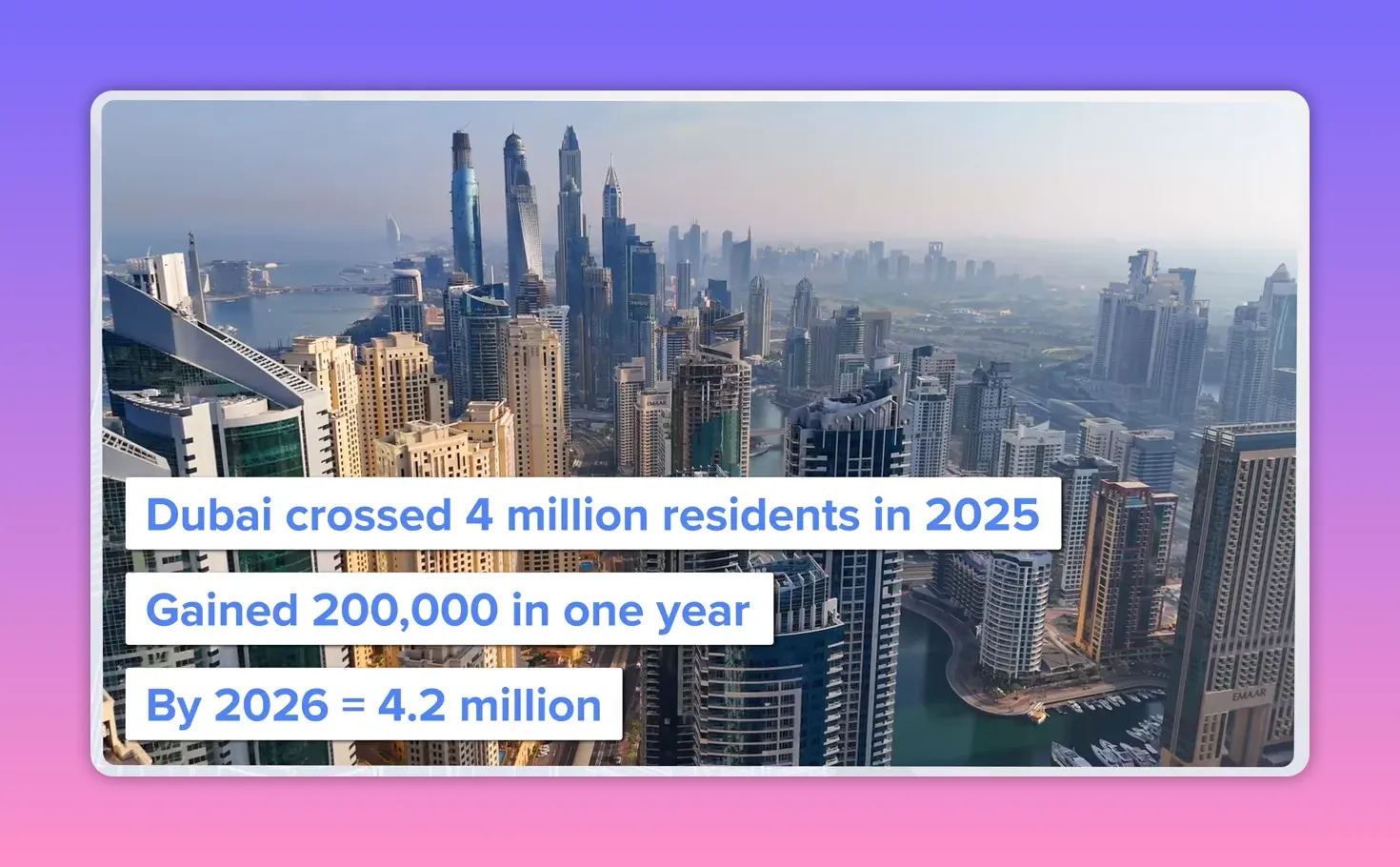
Dubai crossed 4 million residents in 2025, adding around 200,000 people in a single year. Even with more moderate growth, the city is expected to reach roughly 4.2 million by the end of 2026.
That is not just hopeful thinking. It reflects real demographic momentum driven by:
- Job creation
- Business relocation
- Family formation
- Continued inward migration
Now compare that population growth with realistic delivery numbers of around 45,000 to 60,000 units per year.
That comparison changes the narrative completely.
If the population keeps expanding at this pace, actual absorption should remain strong. In other words, new supply is not arriving into an empty city. It is arriving into a market that continues to attract residents, families, professionals, and capital.
This is why I keep saying that anyone trying to Invest in Dubai Real Estate has to look at both sides of the equation. A market can absorb substantial new stock if demand is strong enough.
And right now, Dubai’s population growth remains one of the strongest arguments for long-term resilience.
Dubai’s safe-haven appeal is adding another layer of demand
There is also a bigger force at work here that many people underestimate.
Dubai is often reduced to a simple lifestyle story: sunshine, safety, and tax efficiency. Those things matter, of course, but they are not the full reason global capital keeps flowing in.
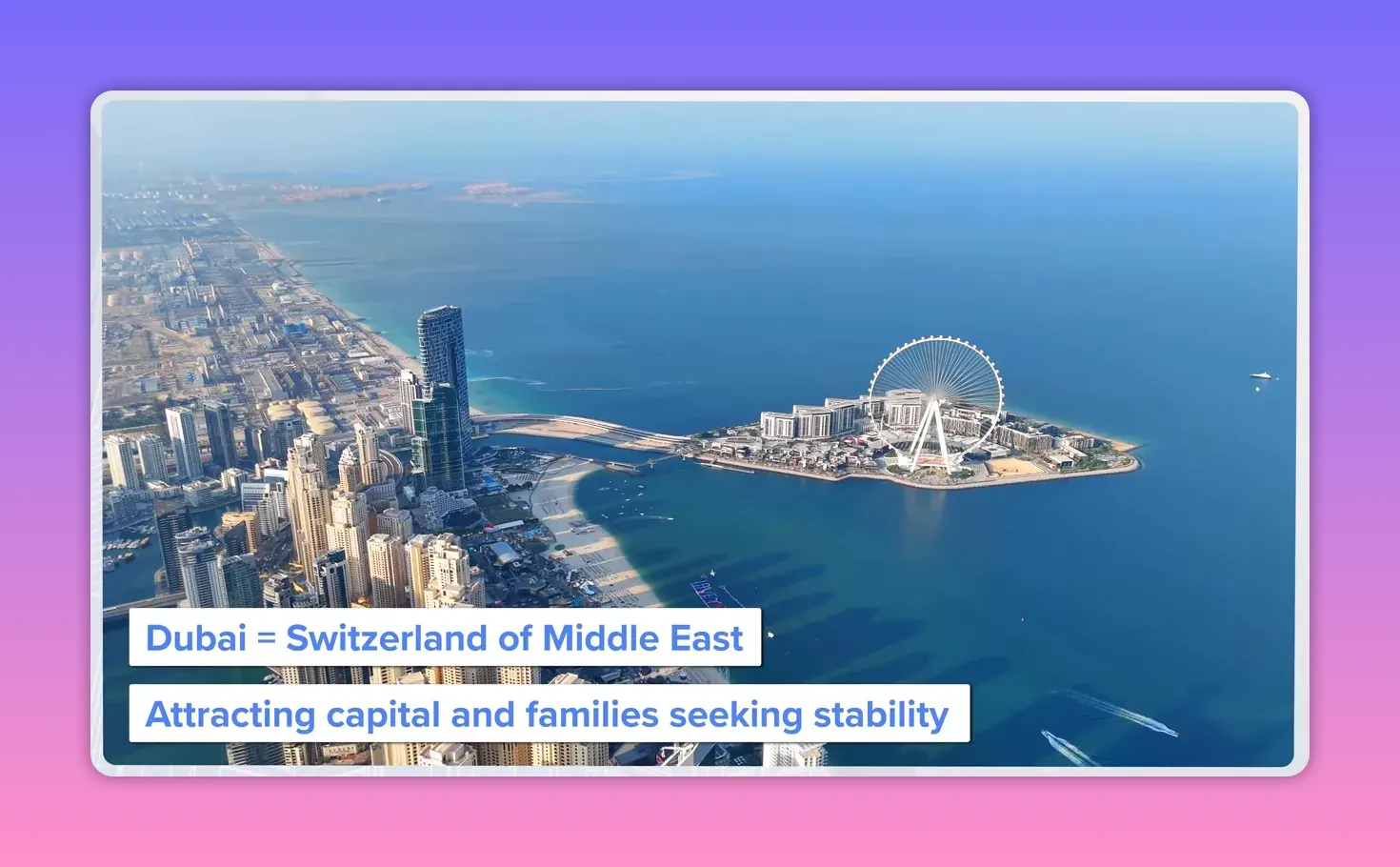
What is really happening is that Dubai has become a kind of safe-haven jurisdiction in an increasingly unstable world.
As trade wars intensify, taxation rises in many countries, and geopolitical uncertainty remains elevated, Dubai has strengthened its position as a place where both capital and families can relocate with confidence.
That gives the city a structural advantage that goes beyond a normal property cycle.
When uncertainty rises elsewhere, Dubai often becomes more attractive, not less. That does not mean every project will perform well. It does mean that the city’s underlying demand base is broader and more durable than many outsiders assume.
Anyone planning to Invest in Dubai Real Estate should keep that macro picture in mind. The demand story is not purely local. It is increasingly global.
The biggest risk in 2026 is not the market. It is execution.
This is the point that matters most.
If the market fundamentals are still relatively solid, why do some investors still lose money?
Because they buy badly.
They assume that any property in a decent location will work. They chase hype. They buy into projects because the recent cycle made everything look easy. And they forget to ask what happened with those same developers before 2020, or how those projects will compete once handover arrives.
This is where problems begin.
Many investors end up in oversupplied towers filled with near-identical units. When the building completes, hundreds of owners are trying to rent or resell the exact same product at the same time.
That creates a very predictable outcome:
- Rental competition intensifies
- Owners undercut each other
- Resale pricing weakens
- Yields fall below expectation
- Exit liquidity becomes harder
This is how a generally healthy market turns into a bad personal investment.
So no, 2026 is not automatically the worst time to Invest in Dubai Real Estate. But it can be a dangerous time to buy commodity stock with no scarcity, no differentiation, and no real end-user appeal.
What to buy instead: focus on scarcity, quality, and end-user demand
If execution is the real risk, then your selection criteria matter more than ever.
The strongest opportunities are not the units attracting the loudest speculator buzz. They are the assets with qualities that remain desirable even when the market becomes more selective.
That means focusing on portfolio-grade properties, not trader stock.
Here is the framework I would use in 2026 if I wanted to Invest in Dubai Real Estate with a margin of safety.
1. Buy from government-backed developers with full-cycle credibility
In uncertain periods, developer quality matters enormously.
You want developers with:
- Strong balance sheets
- Consistent delivery history
- A track record across multiple cycles
- Credibility that extends beyond the recent boom
Anyone can look impressive in a hot market. What matters is how they performed before sentiment improved and whether they can still execute when conditions get tougher.
2. Prioritize prime locations with enduring demand
Not all “good locations” are equal.
The more resilient segments tend to be places with natural scarcity and long-term desirability, such as:
- Waterfront locations
- Low-density villa communities
- Prime areas with strong end-user demand
Scarcity protects value. If there is limited comparable stock and consistent appeal from real occupiers, your downside is usually better managed.

3. Avoid projects with imbalanced unit mixes
One of the biggest traps is buying into developments filled with too many similar units.
Balanced unit mixes matter because they reduce direct competition at handover and improve the chance that the property appeals to actual residents, not just flippers.
If everyone owns the same one-bedroom product in the same tower with the same view and the same layout, pricing power disappears very quickly.
The goal is to own something that has a clear buyer or tenant profile beyond pure speculation.
4. Buy for end users, not just for other investors
This is a simple but powerful filter.
Ask yourself: if short-term traders disappeared tomorrow, would this property still attract strong demand from someone who genuinely wants to live there?
Properties that appeal to end users tend to create more durable long-term value because they are anchored in genuine lifestyle demand, not just momentum trading.
That is a much better foundation when you Invest in Dubai Real Estate in a maturing phase of the cycle.
5. Work with a fiduciary-minded advisor, not noise-driven sales pressure
One of the easiest ways to make expensive mistakes is to act emotionally.
Fear causes people to miss opportunities. Greed pushes them into poor deals. Hype clouds judgment.
A strong advisor should help filter all of that out and bring the conversation back to fundamentals, risk, and suitability.
That means evaluating:
- Your actual investment goals
- Your time horizon
- Your risk tolerance
- The quality of the specific opportunity
- How the asset fits within a broader portfolio strategy
Why waiting can be more dangerous than acting strategically
There is a mindset trap that catches a lot of investors.
They believe caution means waiting until all uncertainty disappears.
But markets never offer perfect clarity. By the time the headlines feel comfortable again, pricing has often already adjusted and the best opportunities have passed.
That does not mean rushing into anything. It means understanding that strategic action usually beats indefinite hesitation.
If you want to Invest in Dubai Real Estate, the objective should not be to find a mythical perfect moment. It should be to identify the right asset, in the right location, with the right developer, at a point where the fundamentals still support demand.
That is how experienced investors navigate uncertain years.
A practical way to think about 2026
Here is the cleanest way to frame it.
2026 is not a year to buy blindly.
It is a year to be selective.
It is a year to question pipeline headlines.
It is a year to compare actual delivery with actual population growth.
It is a year to understand Dubai’s safe-haven demand story.
And above all, it is a year to avoid commodity stock and focus on scarce, high-quality assets with real end-user appeal.
If you approach the market that way, the conversation changes completely. Instead of asking whether it is the worst year to Invest in Dubai Real Estate, you start asking a much better question:
Which assets are most likely to thrive while weaker stock struggles?
Final thought
So, is 2026 the worst year to Invest in Dubai Real Estate?
Not if you know what you are doing.
The market has real headwinds. That much is true. But the deeper fundamentals still matter: realistic supply is lower than the headlines suggest, population growth remains strong, and Dubai’s global safe-haven status continues to support demand.
The real danger is not simply entering the market in 2026. The real danger is entering it badly.
Buy what is scarce. Buy what end users want. Buy with discipline. And treat execution as seriously as timing.
That is how you Invest in Dubai Real Estate without becoming another cautionary story.


